Report compiled from separate reports from John Guyler August-October 2025
Boat Stands for Birdswood
Every two years the charity’s trip boat Birdswood must be lifted out of the water to be inspected: we usually borrow or hire some boat stands for the boat to sit on when out of the water.
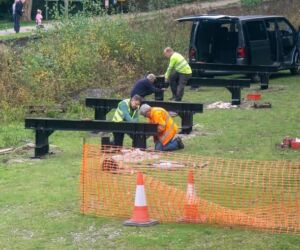
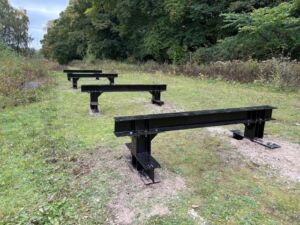
Our colleagues at Pleasley Colliery charity (known locally as the “Pleasley Pit”), offered to supply surplus steel free of charge to us so that we could make our own stands for permanent installation at Cromford wharf. Consequently, our work party teams have spent a significant amount of time, cutting, drilling and welding the steel and finally painting, transporting and assembling the new stands at Cromford.
Pictures below show stands being installed and in position: they will be removed after the boat has been put back in the water.
Preparing for lifting Birdswood out of the water and then cleaning the hull
Two volunteers together with Birdswood crew cut back the trees obstructing the boat lift, and on 23rd October assisted the boat lift and subsequent cleaning the hull of Birdswood ready for the MCA inspection. This was very dirty work, and the team filled half a black bin bag with old paint chippings and residue off the bottom of the boat.
Pinxton Weir: Twelve volunteers continued to clear vegetation and blanket weed near the weir, and separately other volunteers worked near the bridge at the Boat Inn, clearing some thick brambles to get to a large shrub that was that needed thinning out. The other nine volunteers were again working at the weir end where the water level was even lower than before. From the top of the weir to the water level must have been nine inches, which is extremely low. One volunteer was working to clear the rubbish out of the sump on the low side of the weir – an ideal time with low water level.
The group cleared a strip of vegetation very carefully to clear what would have been the water’s edge.
Pinxton Wharf: A team of thirteen volunteers started work clearing the very dense vegetation and the blanket weed from the canal channel. It’s called blanket weed for a very good reason, in this case at Pinxton it had covered the entire channel for about thirty metres from the weir.
Codnor Park Junction: Two FCC volunteers assisted Canal & River Trust staff and a large number of the Codnor Park Fishing Club to clear trees which were growing into a neighbouring field. The Yew trees were being eaten by the horses in that field. Our two FCC volunteers were licenced chain saw operators.
Codnor Park Reservoir: A team cleared a fallen tree: the fishing club ranger reported that a tree had fallen on the far side of Codnor Park Reservoir.
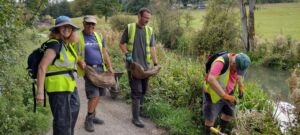
Whatstandwell to Ambergate stretch: FCC hosted a corporate volunteer day with ten volunteers from Orbis Wavin pulling reeds, it proved a very heavy but enjoyable day for some of the volunteers. Some of the volunteers had come from Scotland. The squirrel in the trees overhead caused a great deal of amusement, nuts and bits of twigs were falling down on them.
Ironville: Teams of volunteers have been busy clearing vegetation on the Lock 4 to King William bridge section. The height of the vegetation at water level was about seven feet. At lock 4 the team replaced four rotten fence post on the lock side.
The teams then moved on to the old Lock 1 area at the Pinxton Arm Bridge to clear vegetation there., and then onto Lock 3, clearing vegetation from the top edge stones backing on to the houses. Work party volunteers cleared vegetation from the top of lock 3, past the Pottery up to the road bridge and removed two saplings against the King William Bridge.
Lower Hartshay: Volunteers spent time pulling Himalayan balsam and generally clearing vegetation – mainly big clumps of brambles. The team had the unexpected sight of several large trees being felled near the playground, (not by the FCC).
A work party had a total of nine volunteers on a new area, which DCC (the owners) had requested FCC assistance to work on. It is an old railway track bed, very overgrown with steep sides which was ran alongside the Cromford Canal. The railway construction goes through some very difficult rock sections with trees now growing at the top edges and evidence of the roots gradually being exposed. The work party cleared dead trees and branches from the edge of the footpath and made wildlife habitats.
Two FCC volunteers made two trips to Lower Hartshay from Beggarlee with material to fill in some trip hazards at the far end of the section near the houses. The heavy rain had caused some of the footpath to be washed away that resulted in deep ridges.
High Peak Junction: Volunteers were unable to paint the remaining seats on the canal side, as the materials had been moved from the Length Mans hut to a secure cabinet to comply with new regulations. Instead, the team worked Birdswood crew to remove thistles which were brushing Birdswood to the dis-comfort of the passengers, along the railway narrows
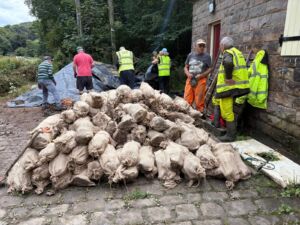
Ten volunteers worked on filling sandbags with clay, for use in filling dog outs, about 100 bags were filled.
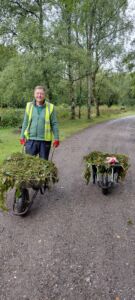
Three volunteers moved reeds which had been cut and piled on the bank at several locations along the walkway to the Wharf Shed: a total of eighty wheelbarrow loads were moved!
Three volunteers were filled various “dog outs” with the clay bags: the bags were brought down to Kelleys corner by the DCC tractor and trailer, where they were piled up for going towards Lawn Bridge.
A technical team inspected Browns Bridge to plan further work required on the bridge decking.