
Compiled and summarized from separate reports by John Guyler – November 2025 to February 2026
Lower Hartshay: A major activity over the winter of 2025 has been on the FCC owned canal at Lower Hartshay to re-lay the old towpath: a grant from Foundation Derbyshire of £1500 has been received for this work. On the first day the plant consisting of two diggers, a dumper and numerous shovels and wheelbarrows and twenty tons of gravel arrived. The towpath at the runoff pipe into the water meadow was dug out where the path has worn much lower than the concrete edge. Several FCC volunteers worked on a hole that had appeared underneath the hedge adjacent to the towpath near the runoff to the water meadow. On investigation the hole was larger than was evident at first sight. It is suspected that the cause was over topping of flood water at that point. The towpath there has dropped slightly allowing runoff in times of heavy rain. The team started to dig the hole out and it finished up 1.0 metres wide and 1.5 metres long with a depth of 1.5 metres.
A further twenty tons of gravel were moved into the into the dugout sections.
A laser was used to check how bad the canal wall had sunk to determine how much material will be required for a further repair to the footpath / towpath.
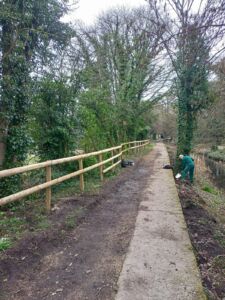
A separate work party continued clearing vegetation, clearing a large bush in the channel near the canal road bridge and sorting the hole at the side of the towpath out. At the same location work was started to remove a Hawthorn tree root which had grown through the canal wall. This proved to be difficult job and will entail the wall being taken down and then rebuilt when the root has been cleared.
Volunteers collected loads of old used bricks, bags of cement and builder’s sand from Beggarlee and transported them to Lower Hartshay and started building the retaining wall in the hole that was dug out adjacent to the footpath.
A large team of sixteen volunteers continued clearing all the cut vegetation, which was disposed of in two controlled burns. The team also worked on the access road to the houses near the road bridge clearing access to remove willow saplings on the water’s edge.
The team also installed six spans of the new fence along the footpath.
Gregory’s Tunnel: A work party met at the wharf shed at High Peak Junction to help load coir rolls on to the trailer for delivery to Gregory’s tunnel area. The coir rolls were laid out on the towpath and tied end to end with thick string and then placed into position on the water’s edge. The metal pins, three in each roll, were hammered through and into the bank, to secure the roll. A total of eighteen rolls in total were installed.
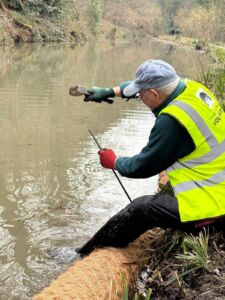
Two of the work party crossed the canal at the tunnel entrance and went back opposite where the coir rolls were being fitted, to clear some bushes and overhanging vegetation and to inspect a silt trap. A chance discovery of an abandoned wheelbarrow was made: the barrow belonged to DCC and the wheel had punctured a while ago and had been abandoned for later recovery but had been forgotten about. The barrow was eventually floated across to the towpath and is now in the lengthmans hut awaiting a new tyre and tube.
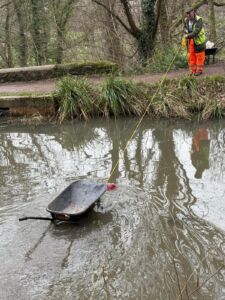
The group cleared pulled reeds off the towpath that had been left from the DCC reed cutter. This meant lots of walking with loaded wheelbarrows a good distance for disposal – altogether just under fifty barrow loads were disposed of.
Chase Road, Ambergate: Nine volunteers pulled reeds from the canal channel and pilled them on the bank to drain before wheel barrowing to disposal later. The previous week Derbyshire Wildlife Trust volunteers had pulled some reeds on to the bank, and these had to be cleared as well as the reeds pulled by our volunteers. The barrows and “cromes” (reed rakes) were supplied by DCC. There were only four wheelbarrows, and the disposal area was good walk away.
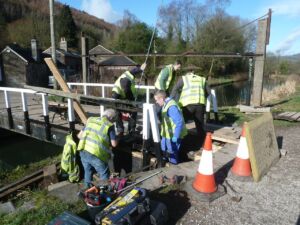
High Peak Junction – Browns bridge: Early training trips by our trip boat Birdswood identified a major problem with the bridge: wood rot means that the bridge is unable to be opened. DCC are planning a major refurbishment of the bridge in the autumn of 2026. Meanwhile the bridge is inoperable. FCC have been authorised by DCC to attempt a temporary fix. Volunteers removed the ballast from Browns Bridge and started to measure up the lengths of steel for fitting to the bridge. DCC are allowing us to use the railway workshops at High Peak Junction to store and work: the team cut, drilled and painted the new straps and brackets for the temporary fix.
Cromford garden centre: With permission of the landowner two volunteers cleared the area around Stella and cleaned the dinosaur.
Sawmills: A group of volunteers worked at the western end of the gauging narrows to clear previously cut vegetation and to clear some of the thick self-sown bushes. A couple of volunteers assisted Robert Shacklock the stonemason on the repair to the bridge, which had damage due to a tree growing through the stonework.
Pinxton Wharf: Previously cut vegetation from near the weir was removed and the team noted several large trees that may require attention this winter. At the Boat Inn mid-morning, there was a presentation from the Amber Valley Rotary Club, of new hi viz for the FCC work parties – the third supply in nine years.
Codnor Park Reservoir: Volunteers removed a tree which had split and was rotten on the inside, cutting it up into manageable lengths for it to be removed from the footpath.
Whatstandwell: A large work party removed pulled reeds to disposal near “Robin Hood”.